AAPS – Run Testing 2022

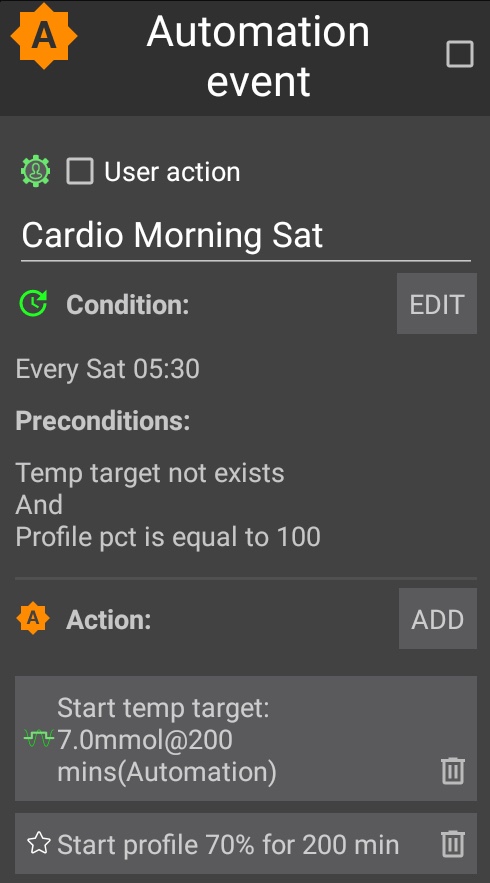
I decided to try using an automation to lower insulin levels and raise my glucose target before doing cardio. This allows AAPS to start this process at 05:30am on my days of choice so that my body is ready to exercise safely and with less need to consume carbohydrates. In my limited testing the process is working well, with some slight tweaking for testing parameters needed. NOTE: I only added half the amount of carbs I consumed to the APS for tracking. This is to avoid overcorrecting by the algorithm.

Expectations

I am trying to find the ideal conditions to exercise where I can experience moderate blood glucose fluctuations and not be required to consume large amounts of carbohydrates to keep me exercising safely. In the past on MDI I used to exercise fasted with only basal on board, which allowed me to stay in range for about 40 minutes before needing carbs. I am hoping to achieve this same amount using a pump. In past experiments I was able to achieve similar results during exercise by significantly reducing basal rates but I found that post exercise I struggled with higher than usual blood glucose readings for a few hours due to lack of insulin in my body.

Automations
Blood Glucose vs. CGM

The CGM results differed during exercise an average of 25% from blood readings. This made me decide to start some research of my own into using machine learning to try and estimate my blood glucose during exercise.

Results / observations

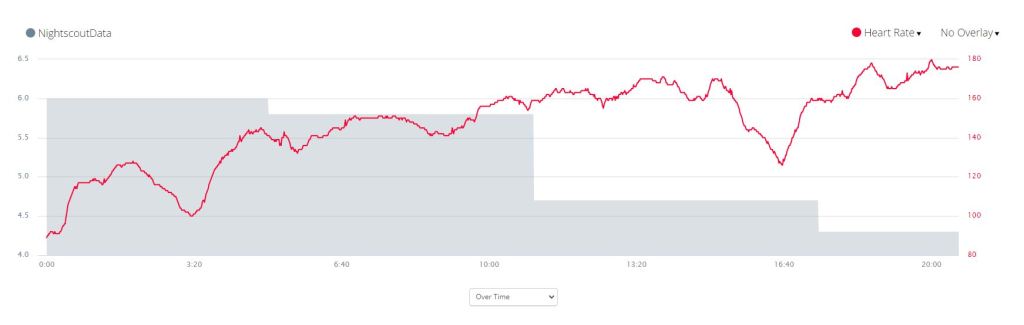
The automation route works well if you plan your exercise far enough ahead. The next experiment I will drop the profile percentage to 60% and observe. I noted an average of about 25% difference between the results the CGM and the finger pick tests. I was however able to keep my readings in range 100% of the time using 34g of carbs for the duration of the 50 minute experiment.

Capture from Nightscout

Video

I created a video using data from my Garmin Forerunner 245 and AAPS to track the experiment. In this video I track blood glucose, insulin, carbs, basal, distance, heart rate and cadence. I noted that the algorithm the Garmin uses to determine distance does not work well while walking and didn’t register any distance until I started lightly jogging.
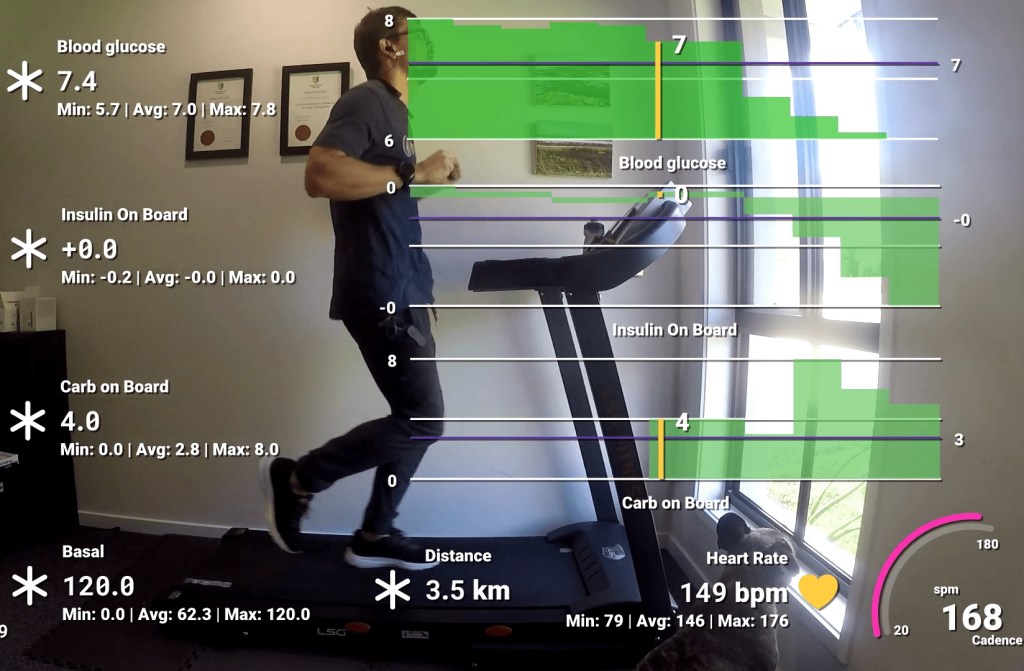
Capture from my GoPro during exercise

Loop (FreeAPS) to Android APS (AAPS) – 3 Week Review

On the 04 February 2022 I decided to switch from FreeAPS (Loop) over to AAPS. At that point I had been successfully looping for 6 months with FreeAPS (Loop) but I wanted to get some experience with the oref1 algorithm in the hopes of fine-tuning my diabetes management during sports and to try out unannounced meals.

I was conflicted in the beginning as I was seeing results consistent with my goals on FreeAPS (Loop), but It was something I wanted to try. I am glad that I did.

The first few weeks on AAPS can be painful as you learn the system and go through the objectives. I had completed as many as I could using a virtual pump so It wasn’t long before I was able to close the loop again this time using AAPS. I expect my numbers will improve once again when automations are available to me.

Setup and Configuration:

For the first few days I was still using the Dexcom IOS app as my collector app sending my BG readings to the King King Mini 2 (KKM2) to be processed by AAPS, this worked well as I was always in areas with reception. I did this because I wanted to be able to switch back to Free-APS quickly if I decided that AAPS wasn’t working for me. The first sensor on the KKM2 I paired with xDrip+. I loved xDrip as it provided heaps of additional data, but I had issues with delayed and missed readings. I have now switched to the the Dexcom BYOD app and this seems to be proving readings more consistently. I am using an Anubis transmitter but I am unable to validate battery level with the Anubis Tool on the KKM2.

Stats:

Last 22 days on Loop (FreeAPS)

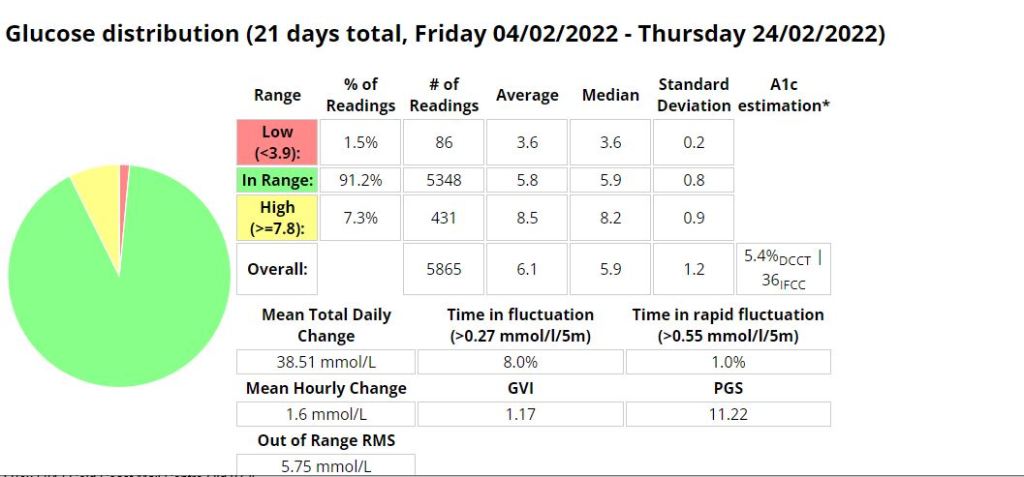
First 21 days on AAPS

Likes:

  • Improved Time-in-range (TIR) (+7.7 %), average blood glucose (-0.2 mmol/l), GVI, PGS and A1C even though AAPS was new to me and I was still figuring a few things out. I achieved this exercising less than I usually do due to weather.
  • Better control with less work.
  • More flexibility – The ability to scale and tailor your meal or correction dose is awesome (include trend, IOB, COB, correction percentage and your blood glucose readings in the the calculation for increased control and precision).
  • Fewer (0.2% less) low events.
  • Quicker to respond to bring high blood sugars down.
  • Unannounced meal management (UAM) using the Oref1 algorithm (not tested).
  • No Apple Developer licence fee (I paid less for my KKM2 than I was paying for my annual developer license).
  • Easier to setup and deploy to the KKM2 than the Free-APS (Loop) app.
  • Remote (SMS) bolus.
  • The ability to super bolus (include basal for a specific period with a bolus).
  • Super micro bolus’ (SMB) are more effective at dealing with gluconeogenesis from high protein meals.
  • Autosens has been useful by identifying periods of insulin resistance or sensitivity and adjusting basal accordingly.

Dislikes:

  • My pump (Medtronic 522) is using batteries more frequently (60% quicker on AAPS).
  • Bluetooth (BT) drop-outs more frequently than loop. In the last 21 days I have had 6 ‘Pump unreachable’ errors and 3 ‘Missed BG readings’. This resulted in elevated blood glucose during the evening.
  • The KKM2 battery drains faster when I am around multiple other Bluetooth enabled devices than what the iPhone did.
  • The connection between the Phone (King Kong Mini 2) to the Orangelink and pump seems a little less stable than with the with the iPhone and loop, but I suppose you can expect a far inferior Bluetooth chip on a phone that costs a 10th of the price. This is easily remedied by restarting the Orangelink , turning BT on and off or in some cases, usually with the the pump unreachable error, I had to restart my phone.
  • I really liked the ICE (Insulin Counteraction effect) data in Loop. It was useful to see where I went wrong with my previous bolus and AAPS doesn’t have this data readily available like Loop did. If you were using UAM it would be unnecessary.

Loop – Day 73 – 2021 Summary

It’s been 73 days since I started looping. I have had a difficult December with a sprained wrist from a mountain bike accident and myself, my daughter and my wife had gastro which resulted in very little sleep and some abnormal readings. In fact I am still having abnormal sensitivity to insulin, resulting in frequent lows or blood sugar swings. I also had two failed Dexcom sensors and moved to the code calibration method which resulted in two days of false high CGM readings in comparison to my blood glucose readings. I’ll add the CGM stats once I am finished the analysis. Hello 2022!

Blood Glucose Stats

Blood glucose stats

A marginal improvement in December over the fist two months, but I still have a lot of work to do to get to my goal of a 5.5% A1C. Interestingly enough, after the gastro I am now 40% more sensitive to insulin, so hopefully now that I am aware of this I can get back to better blood glucose readings. I will also need to run in open-loop when changing Dexcom sensors to avoid all the issues I was previously having with false high blood glucose readings causing my Loop to micro-bolus incorrectly or increase my basal in error. Still not sure how I will handle protein in open-loop.

Exercise Stats 2021-2015

Total distance exercised
Total time spend exercising

I more than doubled (55%) the amount of hours I spent exercising in 2021, mostly as I was working from home which allowed me to spend more time exercising. As my A1C lowered, my fitness levels improved dramatically.

Day 36 – Loop – Exercise – Run

An interesting development from moving over to a pump has been exercise. Whilst resistance training hasn’t resulted in any issues controlling blood glucose (BG), aerobic (cardio) training seems to be heavily impacted by the fast acting insulin being used as basal. My previous strategy was to have no insulin on board (IOB) and fasted, this approach doesn’t work as well when pumping. My ability to stay in range during runs are improving by including fast acting carbs (preferably in liquid form) prior to running, but there is still much tuning to be done. My strategy yesterday was ingesting about 25g of carbs before the run and injecting .3 units just prior to running. I wanted to try this because it was raining and I wanted to disconnect the pump when I ran, as apposed to how I was managing it by reducing basal (50%) 30 min prior to running and for the duration of the run. It was a terrible idea!

I ended up having a little low during the run and then rebounding from adrenaline ( I had a little race with my running partner) from sprinting. This resulted in me needing to wait an extra hour to bring my glucose back into range before lunch.

Time in Range was calculated at <3.9 mmol/l AND >7.8 mmol/l

The daily stats are definitely improving as can be seen by my time in range (TIR) stats above. The morning basal testing revealed that I needed to increase by basal from about 6am up from .8 U/hour to at least 1.1. U/hour, further testing is still required in order to confirm these numbers. I had around 100g of carbs, including ‘fake carbs’ which is added into Loop as 25% of protein and 10% of fat per meal. I’m still not convinced that Loop is particularly effective at managing gluconeogenesis (the conversation of protein and fat into carbohydrates) as I find that if I use 4 hour digestion times I go low and 5 hour digestion times I spike slightly. I suppose more testing in needed πŸ™‚

15 days into starting my Anubis transmitter with Dexcom sensor and so far its working fairly well. I’m interested to see how these sensors hold up on other parts of the body in comparison.

Day 26

Day 26 of this adventure… Its cannula and reservoir change day. I’m slowly getting the hang of it now.
Day 5 of the Dexcom experiment. So far I am not sold. I certainly don’t feel its more accurate than the Libre + miao miao combo (especially with spike as the collector). Once a Libre was calibrated correctly I felt pretty comfortable that I wasn’t having a hypo but the Dexcom was telling me I was a stable 5.6 mmol/l.
I am keen to analyse the accuracy between the two methods. Let the data collection begin.